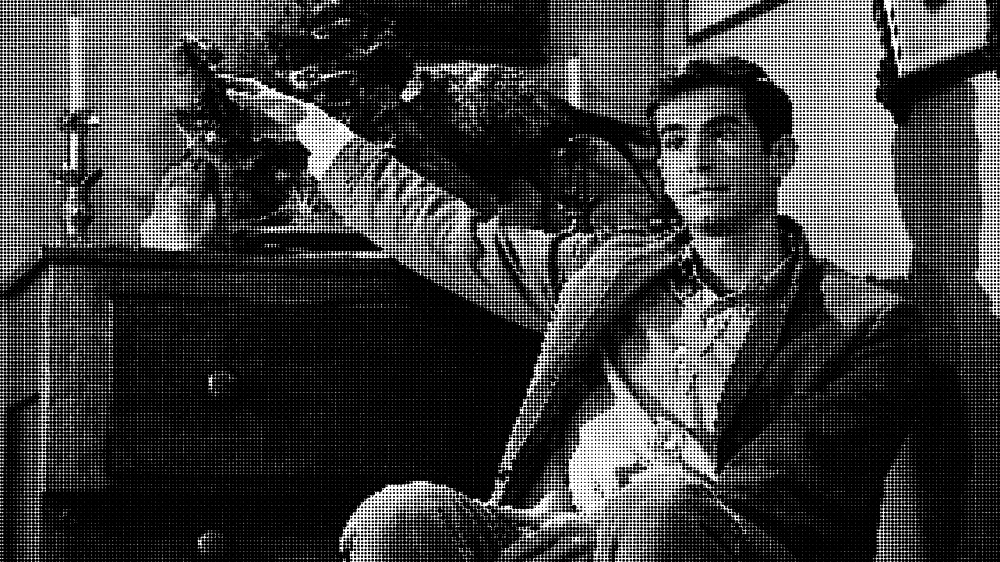
“Young actor Perkins will go on clicking, some Hollywood observers believe, for a long time to come, as few movie actors ever have!“
– Michael Mackay in Newsweek, March 1958
Why Anthony Perkins?
Charles Winecoff was asked this question a curiously high amount of times when he set his sights on writing the first (and to this day most relevant) biography about the actor, who started out as a big-screen-heartthrob for teenage girls and their moms in the 1950s before Hitchcock turned him into Norman Bates. The unsanitized version of this question is: Why this irrelevant has-been? Ultimately, the few people who can put a face to the name Perkins know him from this one exact role. Or maybe a few other, less famous parts where he had played a tormented, neurotic figure. When Hugh Grant turns into the perpetually flustered Brit and Jennifer Coolidge does her blond, quirky, quotable shtick, we know what’s up. A classic example of typecasting. And more than a few might ask “What else is there?”
I’ve always been able to generate an intense interest for this type of career, but even I couldn’t put my finger on why specifically Anthony Perkins had to be my new man of the hour.
In my tender days of youth, I wasted many a night by cruising Wikipedia for a variety of film celeb biographies. Perkins’ article was persistently indecisive on how to frame his private affairs. For the majority of his life, he had dated men, but then he made a radical cut in his forties, married a woman and became the patriarch of an all-American family. In contrast, the narrative on his career seemed agreed upon: After Psycho, he was never able to shake off the sinister motel fiend. The Kafka-adaptation The Trial notwithstanding, he hadn’t been able to follow up with something sufficiently worthwhile.
Maybe my interest was piqued when I found myself in front of this very Wikipedia article and noticed that it had grown quite a bit. Somehow, someone somewhere had gotten hold of Winecoff’s biography and had meticulously added, corrected, elaborated. And suddenly, there were all these fine details and career steps to be analyzed! Had I fallen victim to a common misconception? Wasn’t it, after all, Norman Bates who had knifed down Anthony Perkins’ career, nay, had there been more life in there than previously assumed?
At once, I ordered my very own copy of Winecoff’s Split Image and researched every article, every interview and every accessible documentary I could find. I took a long, hard look at (almost) the entirety of Perkin’s filmography and now I’m here to make a pitiful attempt at summarizing 40 years of a life on screen and 60 years of a life on earth within the length of a research paper. Goodbye to all who prefer to go outside and touch grass and hello to ye who have come to stay and join the investigation: Why Anthony Perkins?
Fear Strikes Out (1957)
Judged by today’s standards, this adaptation of baseball player Jimmy Piersall’s autobiography would have made top-tier Oscar bait. But in the year of our lord 1957, the project seemed rather risqué: Piersall suffered from Bipolar Disorder, which manifested itself in manic tantrums on (and off) the field. This called for an actor who could embody the American heroics of the sport, but also a certain vulnerability. What it definitely must not be was sensationalistic or scary.
It seems pretty confusing that Anthony Perkins, of all people in Paramount’s honey pot, had been chosen for this endeavor – if you’re still thinking about Norman Bates. But Hitchcock was oceans and years away and Perkins had recently celebrated his first (and, unbeknownst to him, last) Oscar nomination for Best Supporting Actor in a contemporary Oscar-bait-feature (Friendly Persuasion, 1954).
Generally, there wasn’t much shocking about his career thus far: Like many eager youngsters looking for a start, he had earned his marks on theatre stages. Little by little, he climbed the ladder. He was showered with his first glowing reviews for his turn as a prep school student in Tea and Sympathy. Said student is rumoured to be gay by his classmates and eventually falls for the wife of one of his teachers (take note: homoerotic subtext, older woman, mommy complex).
Once the studio system got a hold on him, they marketed him as a teen idol, a chipper young buck who recorded chansons and appeared on a popular game show from time to time. The harshest accusation levelled against him was one of eccentricity: In an interview with Mike Wallace, he had to deny eating spaghetti with his hands and emptying a bucket of water over the head of actress Shirley MacLaine.
He, for his part, painted a modest picture of himself in a Newsweek profile:
“I need to be told I’m good because I can give so many arguments why I’m not. I’m absolutely flabbergasted by my lack of qualifications. There are a lot of young handsome actors who have worked much harder but who haven’t had any of the chances I’ve had. I’m not really at all suited to being a star. I’m much too sensitive.”
In an ironic twist, slim, dark-haired Perkins had snagged the lead in Fear Strikes Out from exactly one such young handsome actor named Tab Hunter. Hunter had portrayed Piersall in a previous TV adaptation and embodied the American Boy Next Door-type far more. And he was much better at baseball, too.
This was exactly the point at which the many problems of Anthony P. on set began: He had always been incredibly athletic and health-conscious to a fault, but even going back to his youth, he had had no love to spare for baseball. The extras hired to play his teammates picked up on this immediately – they were demonstrably more proficient players (that’s why they were hired, after all). Accordingly, they spent much of the shooting staring the actor, whom they perceived to be an arrogant sissy, down. Tab Hunter’s frequent visits to the set generated even more animosity.
Yes, reader, you read that right: The one who got cheated out of the role met up with the unlucky winner at work. Because Hunter and Perkins, they were kind of a thing.
The two were some of the biggest American Sweethearts of the late 1950s. Just to contextualize this: Imagine Brad Pitt and Leonardo DiCaprio secretly dating in their 90s prime – that would be the rough equivalent. Maybe Pitt and DiCaprio would have survived unscathed, but if Hunter and Perkins would have been found out, it would have been the bottom line for them. Socially and professionally.
The way Tab Hunter tells it in the documentary Tab Hunter Confidential, he was actually rather prissy about the project, since he, as part of his contract with Warner, had tried to get the big-screen-rights for himself to play the role. But Warner hadn’t quite trusted this handsome, but inexperienced kid yet; He had also been caught partaking in a ‘limp-wristed pyjama party’ by the tabloids.
Usually, the studio happily turned a blind eye in regards to Hunter’s homosexuality, but career-wise, they were now playing hot potato. And he was the hot potato. So behind his back, his boyfriend Perkins went to Paramount and convinced them to buy the rights for himself.
Perkins told him about the betrayal during a ping pong match. It did tamper with their relationship, but the young men also couldn’t let go. They had grown too fond of each other even though, as Hunter readily admits, they were quite different in temperament:
“Thinking back about him now, he was a special part of my journey. If he was shooting a film, I’d pick up a car and drive out to see him and we’d spend time together. I struggled to teach him how to waterski, to get him up on a horse, but he was very bright and quick and had a dry sense of humour and a simplicity and a shyness about him that was very appealing. But my God, he was shy! I think that’s why he was so popular. He wanted to be a movie star more than anything. I wanted that too, but not with the same kind of drive he had. We were such opposites – but then maybe that was the attraction.”
– Tab Hunter for Attitude, June 2018
It wasn’t long before the studioheads at Paramount became privy to the couple’s lunch dates. Perkins was called into office. Upon receiving orders to immediately end the relationship, he simply answered, showing brass balls heavier than any Academy Award could have been: “But I love him!”.
The best stallion in their stable didn’t sprint. Au contraire, the bastard was busy getting driving lessons from his beau, in public and all! For the time being, Paramount had no choice but to let the lovebirds keep going their merry way and try camouflaging the relationship with some lavender alibis. The next cute, young actress willing to stand in for a date was seldom more than a call away, since the girls, too, profited from this marketing scheme.
Some, like Natalie Woods or Debbie Reynolds, quickly picked up on this maneuver. But Perkins, especially, would leave behind more than a few broken (or at least dented) hearts throughout his 40-odd years in the industry. He was a popular subject of rumours surrounding after-the-set-closed-trysts. Which usually turned out to be wrong. But many of Hollywood’s most popular leading ladies claimed to have seriously fallen for him, only to smash against a brick wall of noncommittal niceties. It just so happened with Jane Fonda, who gave her on-screen debut on Perkins’ side in 1960s Tall Story. She would take special care to have her naked body powdered in her dressing room, but Perkins either took no notice or rushed by, head averted. Donna Anderson, who had played his on-screen-wife in the apocalyptic U-boat drama On the Beach, was left even more confused: They had spent every waking minute on set together and played Scrabble off set for days on end, getting along like a house on fire, and then – nothing!
It was the 50s, after all. They were used to omnipresent, superficial harassment from their male colleagues. And then along came this cute guy, who still opened the car door for them, readily draped his coat over their shoulders and genuinely cared about their feelings and opinions, but that was always as far as it went. Even Ingrid Bergman and Brigitte Bardot would get a taste of this trademark ‘Anthony Perkins Experience’. Of course, things never turned too sour for all involved; As a rule, a close friendship was to follow such events. Nevertheless, the public soon grew wise to the fact that Perkins seldom spent more than a few evenings with the same lady. His (supposedly) firm status as a single man earned him the moniker ‘Lonely Tony’.
But back to Fear Strikes Out. On set, co-stars Norma Moore and Karl Malden remained his biggest and busiest supporters. The two juicy, meaty scenes in the script, one of Piersall’s manic episodes during a match and a confrontation between father and son in the psychiatry, thoroughly ate at Perkin’s nerves. Like many co-workers would later attest, Malden came to know his young protegé as very friendly, but a tad introverted, self-critical and reliant on other’s approval. The harsh treatment from a lot of the cast and crew couldn’t have helped, and remember: Because of the Perkins-Hunter-affair, Paramount president Barney Balaban was breathing into his neck practically around the clock.
After much stress and strain, after the movie was finally done, applause seemed to arrive only sparingly. Maybe the subject was a bit too dark and heavy for audiences and awards after all, although the press was rather kind to Fear Strikes Out. Especially Perkins was lauded for his introspective portrayal, which more than makes up for the fact that yes, he obviously wasn’t a natural on the baseball field. Fear Strikes Out de facto, well, strikes out by way of biographical inaccuracy. The father-son-conflict simply didn’t happen in real life, which is why the real Piersall never became a fan of the movie, which is also suspiciously unwilling to ever mention the word ‘bipolar’ (if you happen to be interested in a more accurate retelling, I recommend this documentary on Jim Piersall).
Nevertheless, the flick was successful in cementing itself as a study of a fragile soul under enormous pressure. You might not buy the big baseball star from Perkins, but you will wholeheartedly buy into the torn, eager-to-please son. And a film from the 1950s portraying psychological help not as a horror story out of 1001 Psychiatric Ward Nights, but as an all-around sound idea? Pretty damn worthwhile, especially since Anthony Perkins gets to demonstrate his huge potential for playing tense, withdrawn characters that his next big role will forever link him to.
Psycho (1960)
„What makes “Psycho” immortal, when so many films are already half-forgotten as we leave the theater, is that it connects directly with our fears: Our fears that we might impulsively commit a crime, our fears of the police, our fears of becoming the victim of a madman, and of course our fears of disappointing our mothers.”
– film critic Roger Ebert in his 1998 retrospective on Psycho
Alfred Hitchcock being able to adapt Robert Bloch’s scandalous novel Psycho was already pretty darn risky for Paramount. That he was able to do it the way he did, including naked skin, oedipal subtext and with toilets being audibly used (shock! horror!) was his own very personal risk. One that was only doable by putting his house in as a loan. The studio didn’t even want to offer a set, so Universal had to chime in and save the day, offering the now iconic Bates Motel on their backlot. But Paramount wasn’t ready to take any more risks for Hitch’s ‘dirty picture’. The project was already developing to be a dance with the censorship devil.
And Anthony Perkins played no small part (pun intended) in it; Even though they still marketed him as their well-mannered and decently masculine poster boy. As for every player in the business, getting in with a studio via an exclusive contract had promised prestige and roles on a regular basis. By the late 1950s, Perkins mainly felt the constraints of the arrangement. And he felt the hot sting of missed chances: An offer for one of the leads in Some Like It Hot was rescinded because they were afraid to put the queer actor in drag. The part of Tony in West Side Story somehow didn’t seem ‘manly’ enough. And Pluto, who dreamily gazes at James Dean in Rebel Without a Cause, textual heterosexuality hanging by a thread? Completely out of the question.
Instead, Paramount put him in a number of flops (exotic jungle-junk like Green Mansions alongside Audrey Hepburn, which only had the small benefit of having him sing in it) and made him obediently answer highly substantial interview questions like “Tony, do you prefer Blondes or Brunettes?” (for the curious: The answer was a). The notoriously private part of him was pretty darn annoyed; But the notoriously ambitious part was livid.
Naturally, the Master of Suspense could have called him at this very moment in time and he would have been happy with moldy bread, a jar of tears and a bit part in Alfred Hitchcock Presents. Just his luck, the director had a better deal in store: Norman Bates, who is a deeply unsympathetic, overweight alcoholic in the novel, ought to get a sensitive touch on screen. This way, the murderous twist would affect the audience even more! Hitchcock had seen Friendly Persuasion, in which Perkins had played the wholesome and upstanding son of a Quaker family during the Civil War. So much for a nice contrast. And he also loved the idea of casting the guy who was one of the top contenders for the desired ‘James Dean’s successor’-spot. After all, Perkins had snatched the role in Friendly Persuasion right from Dean as well as the (frankly meandering) East Asian-set drama This Angry Age. In return, like many others, he was beat out by Dean for East of Eden.
Playing the neurotic motel keeper promised a new, deeper, more personal level than Perkins had ever dared to approach before. Much of this was based on the many parallels to his own vita: Like Norman, Perkins had lost his father at a young age. He had been barely five years old when actor Osgood Perkins (known for the 1932 Scarface) had unexpectedly collapsed on stage. Though it must be said that Perkins Sr’s presence in the boy’s life had not been that strong prior to his untimely death. The same could sadly not have been said about Perkins’ mother Janet, whose parenting style could be best described as ‘controlling’. French- and piano lessons, the boarding school, his first small appearances in local theatre productions – all carefully selected and chosen for him by her. Decades later, in an interview with People Magazine, Perkins would recount in a disheartening a propos fashion that she had molested him as well. Yet he never quite managed to break away from her, and she would keep a strong influence on him until her death in 1979.
Just like screenwriter Joe DiStephano, the newly hired lead actor had begun seeing a therapist to deal with his tricky attachment to his mother. Add to the mix Hitchcock, notoriously carrying his own baggage full of sexual and familial neuroses, and you had gotten yourself a trio that would have made Sigmund Freud weep and whip out his calendar, ready to be filled up to the new millennium.
These were the heads that thought up Norman Bates, although Perkins got a surprising amount of freedom to experiment, given Hitch’s near draconian reputation in matters of direction. That’s why the shy momma’s boy is munching on Candy Corn (the most conservative of all sweets) and dressed in the same Ivy League/ college-chic that Perkins was prone to wearing. On the surface, the character is a nominal heterosexual and kills because Mother Bates has made him incapable of properly dealing with a pretty lady in any other way. But as it often is with Hitchcock, the straight text hides a queer reading that Justin Simien (director of Bad Hair and Dear White People) aptly summarizes in Hulu-docuseries Queer for Fear:
“I think you would be hard pressed to find a gay man who doesn’t relate to being driven crazy by his mother’s voice in his head.”
Additionally, Oz Perkins, Anthony Perkins’ son and acclaimed horror director (his film Longlegs made waves just last year), testifies in the same documentary:
“The narrative in my house was: Psycho had been too right for my dad and therefore was the end of him as an actor, really. It was like his coming out and his funeral at the same time. In one swift move the whole jig was up. Psycho was no good for him. It was too good and therefore it was no good.”
America had been very kind to teen idol Anthony Perkins, but that was surface-level. He had already started facing some scrutiny because behind his image, his queerness was rather thinly-veiled (although by no means public) and his whole being lacked machismo.
Accordingly, Janet Leigh, his co-lead and victim in Psycho, remembered him to be a friendly, but inward-leaning man. Like many in his professional orbit, she couldn’t shake the feeling that he was hiding most of his personality and only let carefully chosen facets shine through. The rest was stored far away in a cupboard that Perkins dared to open for Hitchcock and for Psycho. Once the audience had seen him that way – how do you ever close that cupboard again?
It may be hard to imagine now, 65 years on, but even despite becoming Hitch’s most financially rewarding feature and being a hit with the public from the get-go, the reviews were lukewarm at best. Ad infinitem came in the praises for Leigh and Perkins, but plentiful were also the fears that Hitchcock might have sold his soul to sleaze. So says Newsweek in their New Movies-section:
“Hitchcock’s climactic scenes are rather standardly spooky and contrived. But he has milked every drop of excitement from that early stretch – aided and abetted by fine performances from Perkins and Miss Leigh, and from a shot of a showerhead.”
At the 1961 Academy Awards, the movie went home completely empty-handed. Worse still, neither Bernard Hermann’s iconic score nor Anthony Perkins were even nominated.
By all accounts and to the surprise of many, the latter swallowed this bitter pill without much of a fuss. He had enough fun scaring people who left Psycho-screenings and was counting his last days at Paramount. His sights were set towards a new goal: Europe, this magical continent where brave, risky and fresh cinema was being made and where he was worshipped even more than in the U.S.. There was too much scorched earth in Hollywood anyway, since he had recently parted for good with Tab Hunter. Time to head towards greener pastures.
At the very least, in Germany, Perkins was able to net a nomination for a Bambi (a price that used to come with some prestige up here). Even if he and Charlton Heston (nominated for Ben Hur) had to admit defeat against Rock Hudson (winning for Come September), a heartthrob sharing the same closet whose popularity in Germany was without competition at the time. But a Bambi would have been a burdensome doorstopper, anyways – in 1970, however, Perkins got a fountain in front of a grade school in Munich dedicated to him. Everything does balance out somehow!
–
 thistle
Leave a comment