(this article was originally published in German on November 17th, 2022)
“Because it was a hell, and it lives in me forever”
– Elem Klimov
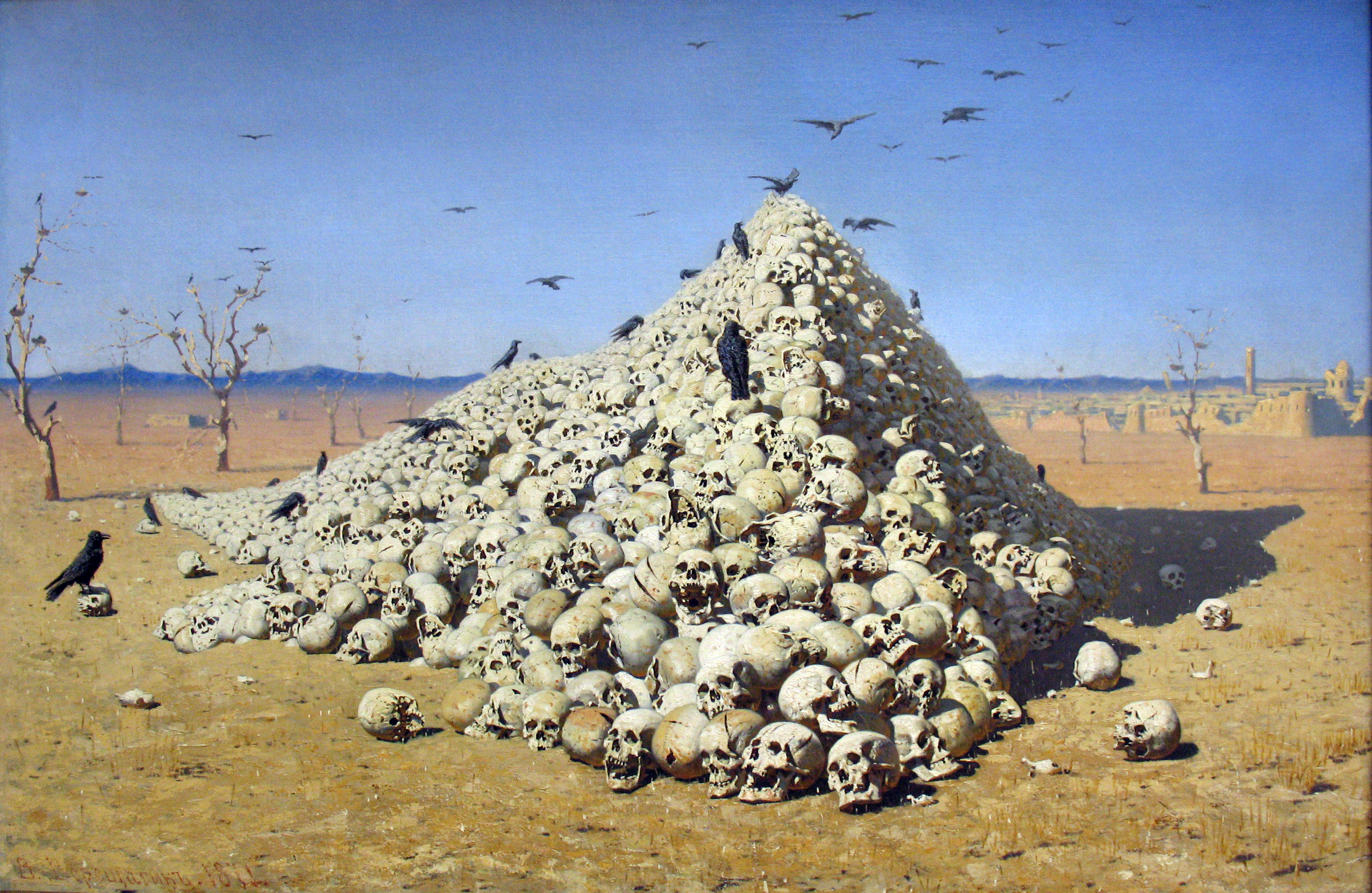
In 1871, Russian artist Wassili Wereschtschagin paints a strange, strange picture: It shows many skulls in a desert wilderness, around them leafless trees and circling crows, the vague hint of a city in the background. The skulls form a pyramid and thus something resembling a Vanitas still life, minimalist and overdrawn at once. It’s a bright scenery with an idyllic blue sky whose perverted beauty appears even more strange because of the food-hungry birds. Just below the center of the picture, one of the skulls is positioned directly facing us, the audience, jaw open wide. We are either being screamed or laughed at.
Wereschtschagin created the piece as part of his “Turkmenistan”-series, a group centering on the Russian wars of conquest in Central Asia. Of the included works, the landscape paintings meet general acclaim, but not the overt post mortem with the title “The Apotheosis of War”. Apotheosis – that’s smart-people-speak for glorification. To complete the affront, Wereschtschagin includes a dedication: “For all great conquerors of the past, present and future”. The Russian army gets it immediately; war art that shows the unglorified consequences of war is not that effective to recruit young blood that ought to be spilled far from home.
More than a hundred years later, director Elem Klimov creates a movie that with time will be regarded as a work of authority within the genre of war cinema. As it so happens, he, too, is a Russian, but his war is a different one. With the biblical call-to-action Come and See, he not only sends us through the darkest forests of Belarussia, but also on the deepest descent into the human soul. He shows us the most all-encompassing destruction that we could ever inflict upon each other.
To understand what makes Come and See so disturbing, so eloquent and so intrinsically true to this day, we ought to go on a search for a man who knew the highest highs and lowest lows of life.
Agony, or a Love Story
Elem Germanovich Klimov is born on July 9th, 1933. His parents are devoted Communists and name him after no less than three icons of the movement: Engels, Lenin and Marx. In a bitter double entendre that is to follow him around for life, “Elem” is also known in the Turkish language as “pain”. The 10-year-old will meet such in spades in the Battle of Stalingrad as he, his mother and brother encounter the cold, the hunger and the brutality throughout their escape. Later on, he will state that it would have been impossible to put all his wartime experiences on film – not even he himself would have looked at the result. But in a gesture that will become characteristic for him, Klimov moves on. After studying aeroplane engineering in Moscow as a young man and a brief and fruitless stint as a writer, he decides to go back to University and become a filmmaker.
At the Gerasimov Institute of Cinematography, the 30-year-old has an encounter that will change his life forever. It is 1963 and there is only one woman enrolled at the Institute: 22-year-old Ukrainian Larisa Shepitko. She is breathtakingly beautiful and unwilling to rely on this attribute, ambitious enough to film her graduation feature Heat in 122 degrees Fahrenheit and fatalistic enough to not let a jaundice infection dissuade her. Of course, she isn’t as taken with him as he is with her, initially. But once he starts helping out during the editing of Heat, it becomes blatantly obvious that they are soulmates. Klimov respects Shepitko and treats her as an equal in life, art and humour. A rare thing during this era, in Russia, coming from a guy. They are married the very same year.
The fact that they are able to spend their time together as intimately as no other couple remains a solemn solace. The state inflicts strict censorship upon Russian filmmakers. Creating young, dissident cinema seems nigh impossible. The two choose different approaches to reach the same goal: Klimov is on the lookout for the truth through humour, the oldest weapon against tyranny. In his feature debut Welcome, or No Trespassing (1964) he spins a parable on the regime through the story of a sleepaway camp commanded by an overtly restrictive school director. The year after, he portrayed the way Russian society deals with ‘extraordinary’ talents in Adventures of a Dentist (said dentist has the miraculous power to painlessly treat patients and he is not a sadist!). In contrast, Shepitko made blood boil in 1966 with Wings, an earnest portrait of a female pilot who has lost herself and her place in society after the war. Even more overtly critical is The Ascent (1977): Two Russian partisans and a young mother are caught up in the fangs of the German militia. One of them commits a despicable, desperate betrayal.
More and more, Klimov has to be her anchor as Shepitko wears herself thin. The increasing harassment from the censorship board causes her to suffer a mental breakdown. Her body is so weakened that giving birth to the couple’s son Anton in 1973 almost kills her. Even still, she returns to set time after time, in pursuit of not the most convenient, but the right way. She directs every movie as if it were her last. For years, she has begged author Valentin Rasputin for the rights to turn his novel Farewell to Matyora into a feature film. When he finally agrees, she throws herself into the project at once.
On July 2nd, 1979, Shepitko is scouting locations in a car with four members of her crew. It’s the wee hours of the morning. The driver might have dozed off a little. Nobody will ever know for sure. All five passengers are killed instantly in the resulting crash. “It was so quick, they didn’t even find adrenaline in their bodies”, friend and fellow filmmaker Andrej Tarkovsky summarizes in bewilderment. For Elem Klimov, this catastrophe is apocalyptic.
Once again, Klimov’s life seems to be in shambles. Many other people would have thrown the towel by this point. But he, again, moves on, mostly because he is on a mission: Farewell to Matyora just has to be completed, no alternatives accepted. After he finishes the movie (now simply titled Farewell) in his wife’s stead, he dedicates a uniquely heartfelt and romantic short film to her memory and carries on her spirit in his work. Elem Klimov, who preferred to say harsh truths through nice pictures, is no more. In Agony, started in 1973 and finished in 1981, he paints a harrowing portrait of the last days of the Romanov Zsar dynasty and of their enigmatic advisor and monk Rasputin. The whole affair is marred by a pervasive sense of doom, combined with perfidiously opulent imagery. Lead actor Alexei Petrenko is mesmerizing as the supposed miracle worker who allows the audience to enter into the depraved underbelly of the bourgeosie. For his next project, Klimov is on the lookout for a similarly powerful performance. It is also going to be his biggest challenge so far: The horrors of his childhood, at last, shall be put to celluloid.
Flyora and the Pale Horse
It’s 1984. It will be a year until the Soviet Union celebrates the 40th anniversary of the victorious end of World War II and Gorbachev’s installment as General Secretary. Goskino, the State Comittee for Cinematography, is in a mood to celebrate and would like a war epic, thank you very much. And Elem Klimov has been sitting on a script about WWII that nobody really wants to sign off on. At this point, the script is entitled Kill Hitler (one wonders why Tarantino didn’t use that for Inglorious Basterds). It’s not only based on Klimov’s own recollections, but also on those of author Ales Adamovich. His 1972 novel Katyn is based on his youth spent as a child soldier serving the Russian partisans.
Goskino may have not forgotten all the barbs Klimov and his late wife Shepitko had sent their way, but you gotta face the facts eventually: Agony did pretty damn well with audiences and the critics, and even more, there was a tangible talent for staging an epic in there that they could really use right now. Especially considering how many of Goskino’s latest co-signed war dramas have been pretty severe flops. So at last, Klimov gets the O.K. to get to work – just kindly rethink that title, they order.
With Come and See, we’re instead treading the solid ground of the Gospel of John. What you’re being asked to take a look at is the four horsemen of the apocalypse, announcing the end of the world and the nearing of hell. Our protagonist Flyora (Aleksei Kravchenko) isn’t wise to any kind of hell. We meet him with a playmate in the Belorusian wasteland, playing war. They squabble over a gun, a leftover from the real war, and get reprimanded by an old man. He is wiser than they are and knows about the infernal pull of weapons. Shortly thereafter, the partisans arrive at Flyora’s home. Aged only 14, he is eager to join them. His father is already fighting at the front; His mother begs him not to leave her and his younger sisters. In 1987, Media scholar Knut Hickethier attested Come and See as being a spin on the ‘Bildungsroman’-concept, and this is very explicit in Flyora’s misguided enthusiasm. He imagines himself to be at the start of a journey into the unknown from which he will emerge as a strong, smart and celebrated hero. He won’t do anything heroic for the entirety of the movie.
In the partisan’s hideout in the forest, first disappointment awaits: Nobody takes him that seriously, and they leave him behind as soon as the German’s approach. Commander Kosach (Liubomiras Laucevičius) orders him to stay and give up his boots to another soldier. To the boy, this is an insult, but we suspect something akin to sympathy and protectiveness behind Kosach’s stony expression. The same could be said for his lover Glasha (Olga Mironova), barely older than Flyora, but convinced that she is much more mature and thus is similarly sullen about being tossed aside. For a brief time, the two are fellow sufferers and travellers, but the majority of the odyssey to come is Flyora’s and Flyora’s alone.
The rest of the plot shall be kept silent, as Come and See is one of those movies that you wish you could rewatch with a fresh pair of new eyes again and again, even if you don’t really enjoy what you’re seeing. With much brutality and nightmarish visions ahead, so far, Flyora’s story has been characterized by uncomfortable insinuations and the beautiful scenery. Belarus was and is a beautiful speck of earth. Klimov knows how to use the luscious forests before he offers swamps and empty fields as stages of horror. From the very beginning, we are captivated by a movie that uses an almost documentary-type style, but more than once also drifts into the dreamlike and surreal. How else do we explain a monstrous Nazi general who keeps an exotic little monkey as a pet? Where does Mozart come from as Glasha, like a fairy, sparkles in the sunlight while dancing in the woods? Some have long maintained that these bizarre elements are a testament to Flyora’s naive psyche that is increasingly influenced by psychosis. Whether you want to follow this interpretation or not, this is what makes Come and See effective and shocking: The singularly accurate portrayal of psychological decay.
In the Swamp of Trauma
There is a pretty iconic scene in which Flyora and Glasha are wading through the swamp. Both seem to be submerged any minute. In an interview, lead actor Kravchenko remembers the morass to be genuinely deep, thick and infested with parasites, and you can feel it while watching. Flyora is looking for something that we, and Glasha, already know he won’t find. But he refuses to accept it and wades deeper in demented fervor. It is a nigh perfect metaphor for the cruelty of trauma: You are tuned into something other people just don’t feel with the same intensity and urgency as you are. They don’t know the swamp you’re drowning in. The swamp is yours alone. Trauma is also keen to latch onto the strangest little details, and maybe that’s where Mozart and the monkey are coming from. Elem Klimov shows us Flyora’s swamp, and he shows everything before and after. The boy himself can barely express to others what he is going through. It’s a gradual death of language, because there is no vocabulary for his trauma.
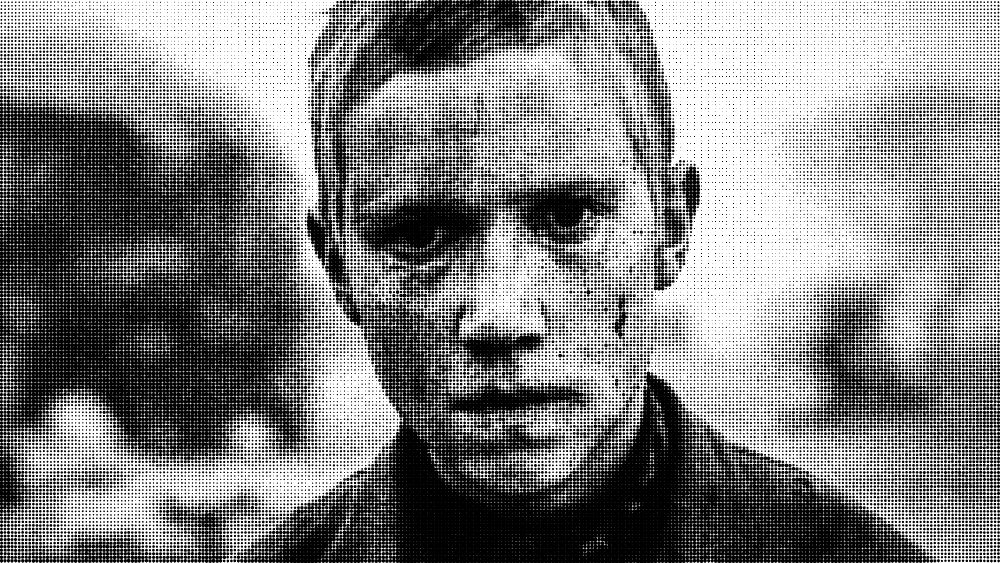
Another facet of this trauma-treatment is the tendency to show the dramatis personae’s faces in close up, staring right into (and through) the camera. This returns the focus to the individual in a war whereas elsewhere, the individual is just a tool to accompany the viewer through a war. This technique has also been referenced by the most recent adaptation of All Quiet on the Western Front (2022), which wasn’t nearly as effective. Why? Because Paul Bäumer’s face is deeply shaped by the signs of trauma after his first voyage into the French trenches, and this isn’t really built upon throughout the rest of the movie, no matter what unhuman circumstances he meets. But trauma sums itself up and eats at your being. In Come and See, we watch Flyora fall apart. Aleksei Kravchenko portrays this as if his life depended on it, and he is prepared by Klimov in a pretty relentless fashion.
Kravchenko never intended to be an actor; When radio announcements look for blond, blue-eyed boys, he merely goes along to the casting with a friend and is discovered himself. As an introduction, he is shown two hours of grisly war and Holocaust footage by Klimov, who offers him a piece of cake afterwards (Kravchenko declines). The director has already worked with hypnotists on the set of Agony and hypnotists are again invited to this set, employed to spare the young boy from permanent psychological harm. He reveals himself to not be susceptible to hypnosis. Throughout the nine months of filming, he is largely without parental supervision. Following a crash diet, the 14-year-old rapidly loses weight for the role. Contrary to circulating rumours, his hair doesn’t start greying for real, but the silver-paste remains stuck in his hair long after the last take has been shot. Later on, Klimov will profess his relief that Kavchenko did not go insane, though he did go on to become an actor as an adult.
This uncompromising approach works itself into the entirety of shooting. Authentic war machinery is borrowed from the military, lest that the viewers don’t mistake the sounds for toy guns. The whole sound design follows this realistic, palpable production, which is why genuine rounds are fired above the actor’s heads. Without wanting to get too much into this discourse: It’s been almost 30 years since actor Brandon Lee was famously shot and killed on the set of The Crow, due to faulty gun prepping. Lee gave a really moving performance in the movie that I wish was more talked about than his death; In a better world, he’d be 57 now. As understandable as Klimov’s effort to not sugarcoat the horrors of war is, no masterpiece is worth a cast- or crewmembers life or mental stability.
Nevertheless: It is a masterpiece. When people talk about the fact that Come and See is such a terrific war movie, it is probably because it shows not only what war makes some people capable of, but how it leaves many, many others behind. Near the end, Flyora is standing quite near his home village, but everything has changed. Detlev Kannapin writes in Film und Krieg: Die Inszenierung von Politik zwischen Apologetik und Apokalypse:
“These familiar surroundings now appear as a ghost world. Never again will he be able to live a carefree life here.”
There is no apotheosis in this. What Flyora has gone through cannot be apotheosised.
It’s the End of the World, and I Feel Fine?
There won’t be a film after Come and See for Elem Klimov; Later, he will state that he had said everything there was to say. According to rumours, he does start to work on other projects, among them an adaptation of Master and Margarita by Michail Bulgakov, an endeavor many others (Roman Polanski, for example) struggle with. Some suggest that Klimov loses himself to alcohol over the lingering grief surrounding Larisa Shepitko’s death. Maybe he is busy being a single parent. He gets to see the ecstatic response his swan song Come and See gets over the years before dying in 2003. A long, hard, extraordinary life lies behind.
If my appeal wasn’t blunt enough: Come and See this movie. Especially if you have the privilege to see it for the first time. Back in 1984, Klimov not only made this movie to work through the ghosts of his past, but staring into the ugly face of the Cold War. It is now 2022. Come and See ist 37 years old. Yet again, there is a war, because as humans we simply cannot stop spinning apotheoses. Two days ago, amidst the ongoing battle between Russia and the Ukraine, rockets were dropped in hereinbefore uninvolved Poland. The world is not a pretty place right now and I understand that you might not want to be confronted with how seriously un-pretty it is.
Come and See never fails to remind me what people are capable of doing to each other. Which is why I can never watch it more than twice a year, but at the same time feel like I have to, again and again. But even more often, I think of a Russian and a Ukrainian who were brave enough to fall in love and share a life, almost 60 years ago now. In a pragmatic sense, they left us Anton Klimov, who honours their memory to this day and works as a journalist for a government-critical website. Their movies, too, are their gift to us. Most of all, the story of Elem Klimov and Larisa Shepitko reminds me that people can also be wonderful to each other. It’s almost like moving on is worth it, in the end.
–
 thistle
Leave a comment